01 The two numbers that decide a shot
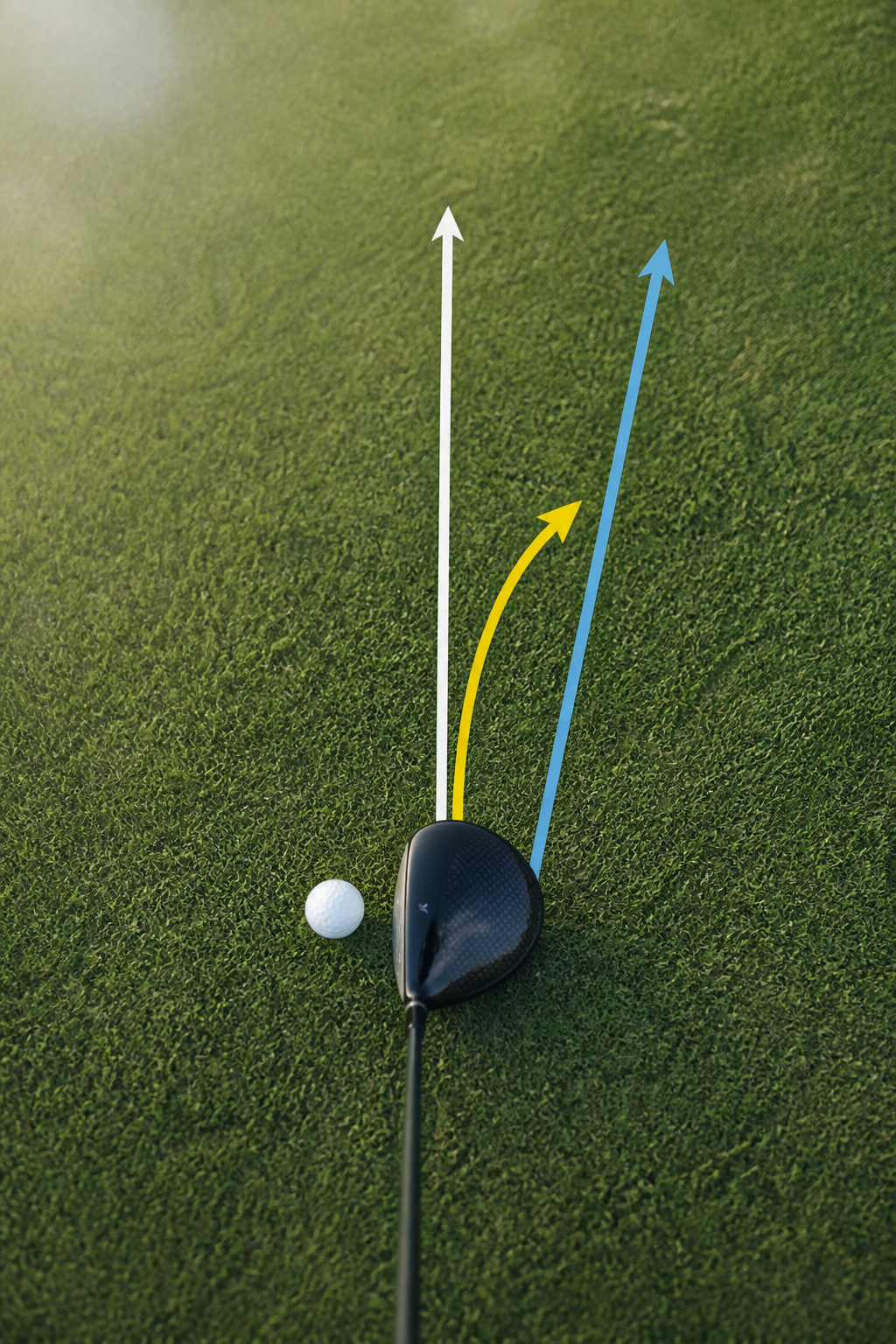
Face angle is where the club face is pointing at the moment of impact, measured against the target line. Pointing right of the target it is open, pointing left it is closed.
Club path is the direction the club head is travelling through impact, again measured against the target line. Travelling out to the right it is an in-to-out path, travelling left it is out-to-in. Path is not the same thing as swing plane, and it is not the same thing as where your feet point.
Everything else that gets discussed on a driving range, grip, posture, the position of the left elbow, matters only in as much as it changes these two numbers and where on the face you strike the ball. That is the whole reason this chapter comes first: it turns a shapeless complaint ("I slice") into a measurable statement ("my face is four degrees open to a path that is six degrees left").
02 Start line comes mostly from the face
This is the part that overturns what most golfers were told as juniors. The ball does not start along the swing path. It starts close to where the face is pointing. Measurements published by launch monitor manufacturers put the face at roughly eighty-five per cent of the initial direction with a driver, and around seventy-five per cent with an iron, with the path making up the rest.
The practical consequence is blunt: if your ball starts well right of the target, the face was open at impact, whatever your swing looked like. Aiming further left will not fix it, and usually makes it worse, because aiming left tends to send the path further left, which widens the gap that creates the curve.
The face share is higher with a driver because the club is longer and the loft is lower. Loft matters here: a lofted face directs more of the impact force upward and slightly reduces how much the face dominates the horizontal start direction. It is one of the reasons a wedge is much harder to start badly offline than a driver.
03 Curve comes from the gap
Curvature is produced by the face-to-path relationship, that is, the face angle measured against the club path rather than against the target. When the face is open to the path, the ball curves right. When it is closed to the path, it curves left. When face and path agree, the ball does not curve at all, whatever direction they both point in.
The mechanism is a tilted spin axis. A golf ball leaves the face spinning backwards; the impact conditions tilt that axis to one side, and the ball drifts towards the low side of the tilt. There is no such thing as pure sidespin on a struck golf ball, which is why the modern vocabulary talks about spin axis rather than side spin.
A small gap, on purpose
A shot shaped deliberately uses a small gap, usually one to three degrees. A gentle draw is a path a couple of degrees right of target with a face very slightly right of target but left of the path. The ball starts a touch right and drifts back. Because the gap is small, the curve is small and predictable, which is exactly what makes a shaped shot playable.
A large gap, by accident
The classic amateur slice is a large gap. A path six degrees left of target with a face two degrees left of target leaves the face four degrees open to the path: the ball starts slightly left and curves hard right, and the harder it is hit the more it curves, because more ball speed and more spin exaggerate the same tilt. This is why swinging harder makes a slice worse rather than better.
Caddie note
Fix the path before the face. A golfer who closes the face to stop a slice, without changing the path, converts a slice into a pull that starts left and stays there. The gap has not moved, only the direction both numbers point in.
04 The nine ball flights
Three possible start directions multiplied by three possible curves gives the nine flights every golfer has hit at some point. Read the table by finding your own shot in the first two columns, then reading across to what the face and the path must have been doing.
| Starts | Curves | Common name | Face against target | Face against path |
|---|---|---|---|---|
| Left | Further left | Pull hook | Closed | Closed |
| Left | Not at all | Pull | Closed | Square |
| Left | Right | Pull slice | Closed | Open |
| At target | Left | Draw or hook | Square | Closed |
| At target | Not at all | Straight | Square | Square |
| At target | Right | Fade or slice | Square | Open |
| Right | Left | Push draw | Open | Closed |
| Right | Not at all | Push | Open | Square |
| Right | Further right | Push slice | Open | Open |
Two rows deserve attention. The pull slice, starting left and finishing right, is the most common amateur miss and the one that looks most confusing, because the two ends of the flight point in opposite directions. And the push draw, starting right and drifting back, is what most good players are aiming for: it needs the path right of target and the face between the target and the path.
05 Strike: gear effect and smash factor
Face and path explain direction, but where on the face you hit the ball changes the flight on its own, without any swing change at all. A driver head is not flat: the face curves horizontally (bulge) and vertically (roll), and it has to, because of gear effect.
When the strike is towards the toe, the head twists open around its centre of gravity and the ball is given draw spin. A heel strike twists the head the other way and adds fade spin. The bulge is built in to compensate: it starts the ball slightly further offline in the direction that the gear effect spin will bring it back from. On the vertical axis the same thing happens: a strike high on the face reduces spin, a strike low on the face increases it, which is why a high strike with a driver often flies further despite feeling less solid.
Smash factor is ball speed divided by club head speed, and it measures how efficiently the strike transferred energy. A centred driver strike sits close to 1.50, which is near the ceiling set by the equipment rules limiting the spring-like effect of the face. Lofted clubs produce lower figures, because more of the impact goes into spin and launch: a seven iron typically lands around 1.33. If your smash factor is low, the answer is almost never a new driver, it is where you are hitting the face.
Caddie note
Foot spray or face tape on the club face for ten shots will tell you more about your driver than an hour of video. Most golfers who believe they have a swing problem have a strike pattern spread across two inches of face, and the flights they cannot explain are gear effect doing its job.
06 Diagnose your own slice in three shots
You do not need a launch monitor to read your own numbers. You need a straight edge on the ground pointing at a target, and the discipline to watch the first thirty yards of the flight rather than where the ball finishes.
- Watch the start, not the finish. Hit three balls and note only where each one crosses a line thirty yards ahead: left of target, at it, or right of it. That tells you the face angle.
- Watch the curve separately. On the same three balls, note whether the flight bent left, bent right, or held straight. That tells you the face-to-path gap, not the path on its own.
- Combine them. Start left with a right curve means a closed face and a more closed path: work on the path. Start right with a right curve means an open face and an even more open gap: work on the face first, then re-check.
If the strike is scattered across the face, do this test again once the strike is tighter. Gear effect from a toe or heel strike can invent a curve that has nothing to do with your path, and chasing it will send you somewhere unhelpful. Persistent left or right misses that survive a clean centred strike often point at the clubs rather than the swing, which is covered in what a fitting can and cannot change: lie angle alone will move a well struck iron shot several yards offline.
07 Drills that move the numbers
Three drills, one for each variable. Use half swings until the pattern changes, then rebuild speed. None of them requires equipment you cannot carry in a golf bag.
- Strike, the tee gate. Two tees pushed into the turf just wider than the club head, ball in the middle. Twenty half swings without clipping either tee. This tightens the strike pattern before you try to change anything else.
- Start line, the alignment stick window. Push a stick into the ground five yards ahead, two feet right of the target line, and hit shots that start between the stick and the target. Because start line is mostly the face, this is direct face training with instant feedback.
- Path, the outside headcover. Place a headcover a few inches outside the ball and slightly behind it. An out-to-in path hits the headcover; a path that swings out to the right misses it. Start at half speed, because the first attempts are usually a long way off.
How to arrange these drills across a session, and why the version that feels worst while you are doing it is frequently the one that reaches the course, is the subject of the chapter on practice.
Once the flight is repeatable, the same understanding carries into the shots that decide most scores. Around the green the club face matters even more, for a different reason, and that is where bounce and landing spots take over. On the greens neither face nor path is the problem, which is why putting is treated as a speed question in the next chapter.
08 Terms used on this page
These seven terms are the vocabulary the rest of the guide assumes. Every other term used across the eight chapters is collected in the glossary.
- Face angle
- The direction the club face points at impact, measured against the target line. Open points right of target, closed points left.
- Club path
- The horizontal direction the club head is travelling at impact, measured against the target line. In-to-out points right, out-to-in points left.
- Face to path
- Face angle measured against the club path instead of the target. This difference, not the face on its own, produces curvature.
- Spin axis
- The tilt of the ball's axis of rotation. A tilt to the right sends the ball right; a level axis produces a straight flight.
- Attack angle
- Whether the club head is travelling downward or upward at impact. Negative with irons, so the ball is struck before the turf; often positive with a driver from a tee.
- Gear effect
- The spin added by an off-centre strike as the head twists around its centre of gravity. Toe strikes add draw spin, heel strikes add fade spin.
- Smash factor
- Ball speed divided by club head speed. Around 1.50 for a well struck driver, lower for lofted clubs.