01 Speed decides more than line
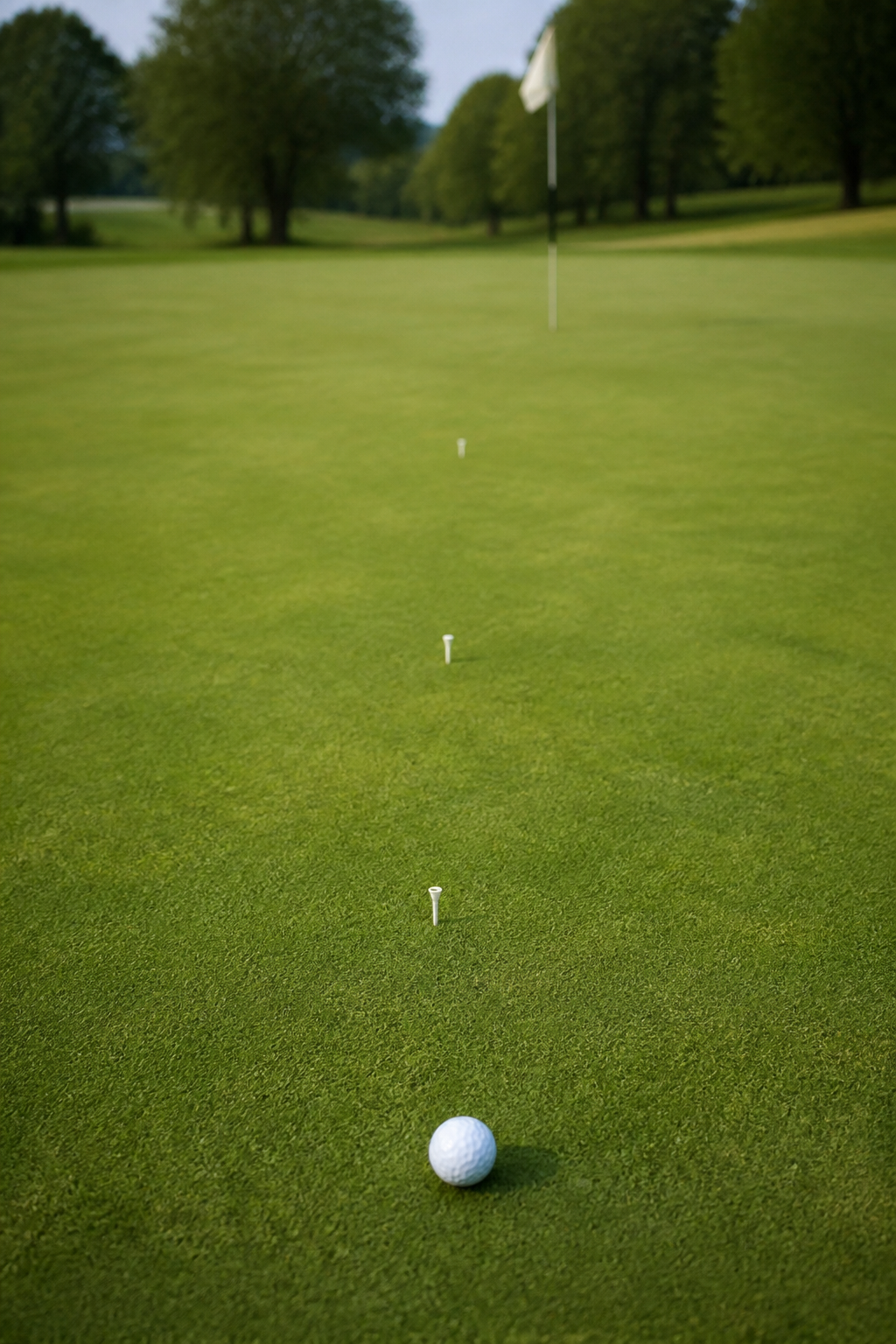
Break is not a fixed property of a putt. It is a consequence of how long the ball spends on the slope. A putt struck firmly spends less time being pulled sideways by gravity and takes less break; a putt dying into the hole takes far more. This is why two players can read the same putt differently and both be right: they are planning different speeds.
It also explains the most common miss in amateur golf, the putt that is read with plenty of break, struck too hard, and misses on the high side while running eight feet past. The read was not wrong. The speed made it wrong.
Testing published by the short game researcher Dave Pelz pointed to an optimum pace: a ball rolling at a speed that would carry it roughly seventeen inches past the hole holds its line best over the last few feet and still has enough energy to fall in off the edges of the cup. The exact figure matters less than the principle. Decide the speed, then read the line that speed will take.
02 Green speed and the Stimpmeter
A Stimpmeter is a simple grooved ramp. A ball is released from a notch on a flat part of the green, and the distance it rolls, in feet, averaged over rolls in both directions, is the reading. A green that reads nine means the ball rolled an average of nine feet. The device was devised by Edward Stimpson in the 1930s and adopted by the United States Golf Association in the 1970s, which is why the same number is understood everywhere.
Most club greens sit somewhere between eight and ten feet in normal conditions. Championship setups are usually prepared faster, often between eleven and thirteen. The difference is enormous in practice: on a green reading twelve, a putt takes roughly a third more break than the same putt on a green reading nine, and a lag putt that finishes stone dead on one will run five feet past on the other.
Caddie note
The practice green is not decoration. Five lag putts before you tee off, on the day's actual green speed, is worth more than half an hour of stroke work. You are not warming up your stroke, you are calibrating it to today's conditions.
03 Make rates worth believing
Shot tracking on the PGA Tour has produced make rates by distance that have been published for years and change only slightly from season to season. They are useful to an amateur not as a target but as a reality check: they show where the makeable zone ends and the two-putt zone begins, for the best putters in the world on immaculate greens.
| Distance | Tour make rate, rounded | What that means for your round |
|---|---|---|
| 3 feet | Around 95 per cent | Expected. Practise these until they are boring. |
| 5 feet | Around 75 per cent | Still a make. This is the length that decides scores. |
| 8 feet | Around 50 per cent | A coin flip for the world's best. Anything beyond is a bonus. |
| 10 feet | Around 40 per cent | Roll it in the door and accept the two-putt. |
| 15 feet | Around 23 per cent | Speed only. Aim to finish inside three feet. |
| 20 feet | Around 15 per cent | A lag putt with a chance, not a putt you should expect to make. |
| 30 feet | Under 10 per cent | Pure distance control. Three-putt avoidance is the whole job. |
The consequence for practice time is stark. Nobody makes a living from thirty footers, and the golfer who spends every practice session rolling long putts at the hole is training the wrong skill. From long range the target is a three foot circle. From five to eight feet the target is the hole, and that is where repetition pays.
04 Reading the last third of the putt
A ball breaks most where it is slowest, which is near the hole. That single fact reorders how a putt should be read. The slope under your feet at the ball tells you very little; the slope in the last few feet before the hole tells you almost everything.
- Walk to a point level with the hole, about halfway along the putt, and look across the line. Slope is easier to see from the side than from behind.
- Read the last third first: decide how the ball will behave in the final three feet, then work backwards to a start line that delivers it there.
- Pick an intermediate target, a discoloured blade of grass or an old pitch mark, no more than a foot or two ahead of the ball, and aim at that. Aiming at something a foot away is far more accurate than aiming at something thirty feet away.
Grain matters on some grasses, notably bermuda, where the direction the blades lie can add or take away speed. A simple check is to look at the cup: the side where the edge looks ragged and brown is usually the direction the grain is growing towards, and putts run faster that way.
05 Two drills without a putting green
Distance control is a feel for how far the ball rolls per unit of backswing. That can be trained on any flat carpet, in any month, which makes it the one part of golf that survives a closed course.
- The wall drill. Put a folded towel against a wall and putt from ten feet away, trying to finish the ball touching the towel. Ten balls, count how many finish within a hand span. You are training roll-out, not line.
- The clock, for the short ones. Six balls in a circle at four feet around a hole or a coin. Hole all six in a row before you stop. If you miss the fifth, start again. The pressure of starting over is the point of the drill.
Both drills reward a repeatable length of stroke rather than a repeatable amount of effort, which is the same skill trained by the ladder drill in the short game chapter. Both also work far better when they carry a score, for the reasons set out in the chapter on practice. If distance control still refuses to settle, the putter itself is worth checking: length and lie affect where the ball starts, as described in the fitting chapter.
06 The three-putt audit
For three rounds, write two numbers on your card: total putts, and how many first putts finished short of the hole. The second number is the one that matters. A player whose lag putts are consistently short is not misreading greens, they are decelerating, and no amount of green reading will fix that.
Then count three-putts by distance. If they come from beyond twenty-five feet, the fix is the ladder drill and better approach play. If they come from inside fifteen feet, the fix is the four foot clock drill, because the second putt is the one being missed. The two problems look identical on a scorecard and need opposite practice.
Recording this properly also feeds the scoring side of the game: a handicap is only as informative as the scores you post, and how those scores turn into a number is explained in the handicap chapter.